1. Les trois rapports
Dans un triangle \(ABC\) rectangle en \(A\), pour l'angle aigu \(\widehat{B}\) :
\[\cos\widehat{B} = \frac{\text{adjacent}}{\text{hypoténuse}} = \frac{AB}{BC}\qquad\sin\widehat{B} = \frac{\text{opposé}}{\text{hypoténuse}} = \frac{AC}{BC}\qquad\tan\widehat{B} = \frac{\text{opposé}}{\text{adjacent}} = \frac{AC}{AB}\]
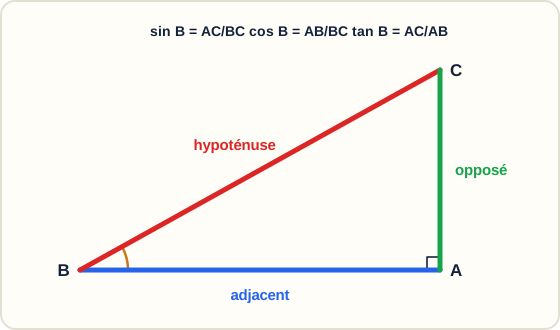
Figure — côtés opposé, adjacent et hypoténuse pour l'angle B
Pour un angle aigu \(x\) : \(0 < \cos x < 1\) et \(0 < \sin x < 1\).
2. Relations
$\(\cos^2x + \sin^2x = 1 \qquad \tan x = \frac{\sin x}{\cos x}\)$
Si \(x\) et \(y\) sont complémentaires (\(x + y = 90°\)) : \(\sin x = \cos y\), \(\cos x = \sin y\) et \(\tan x = \frac{1}{\tan y}\).
Exemple : si \(\cos x = 0{,}6\) alors \(\sin^2x = 1 - 0{,}36 = 0{,}64\), \(\sin x = 0{,}8\) et \(\tan x = \frac{0{,}8}{0{,}6} = \frac43\).
3. Valeurs remarquables
| \(x\) | \(30°\) | \(45°\) | \(60°\) |
|---|---|---|---|
| \(\sin x\) | \(\frac12\) | \(\frac{\sqrt2}{2}\) | \(\frac{\sqrt3}{2}\) |
| \(\cos x\) | \(\frac{\sqrt3}{2}\) | \(\frac{\sqrt2}{2}\) | \(\frac12\) |
| \(\tan x\) | \(\frac{\sqrt3}{3}\) | \(1\) | \(\sqrt3\) |
4. Calculer une longueur ou un angle
- Longueur : \(ABC\) rectangle en \(A\), \(BC = 10\), \(\widehat{B} = 30°\) : \(AC = BC\sin30° = 5\) et \(AB = BC\cos30° = 5\sqrt3\).
- Angle : si \(\tan\widehat{B} = \frac{3}{4}\), la calculatrice donne \(\widehat{B}\approx36{,}9°\) (touche \(\tan^{-1}\)).